
Earnings season is when insider data earns its keep, and also when it is easiest to misread. The Insider Sentiment Gauge reads the trailing 12 months of Form 4 filings, so it will never predict a print. What it does is tell you what insiders were doing before the print, and whether they changed their minds after it. Six checks, in the order we run them:
1. The week before a report: who already moved?
Start from the earnings calendar, pick the names you hold, and gauge each one. A stock heading into earnings with insiders net buying over the past year is a different hold from one where the only traffic is selling. The gauge verdict and the buy share of traded dollars are the two numbers to write down.
2. After the recap: did the story change?
Our Netflix recap covered an EPS beat with a weak guide, the exact setup where post-earnings insider trades carry information. Wait for the first Form 4s, run the gauge again, and compare the month bars. New buying after a weak guide says more than any headline.
3. One seller is a person; three sellers are a pattern
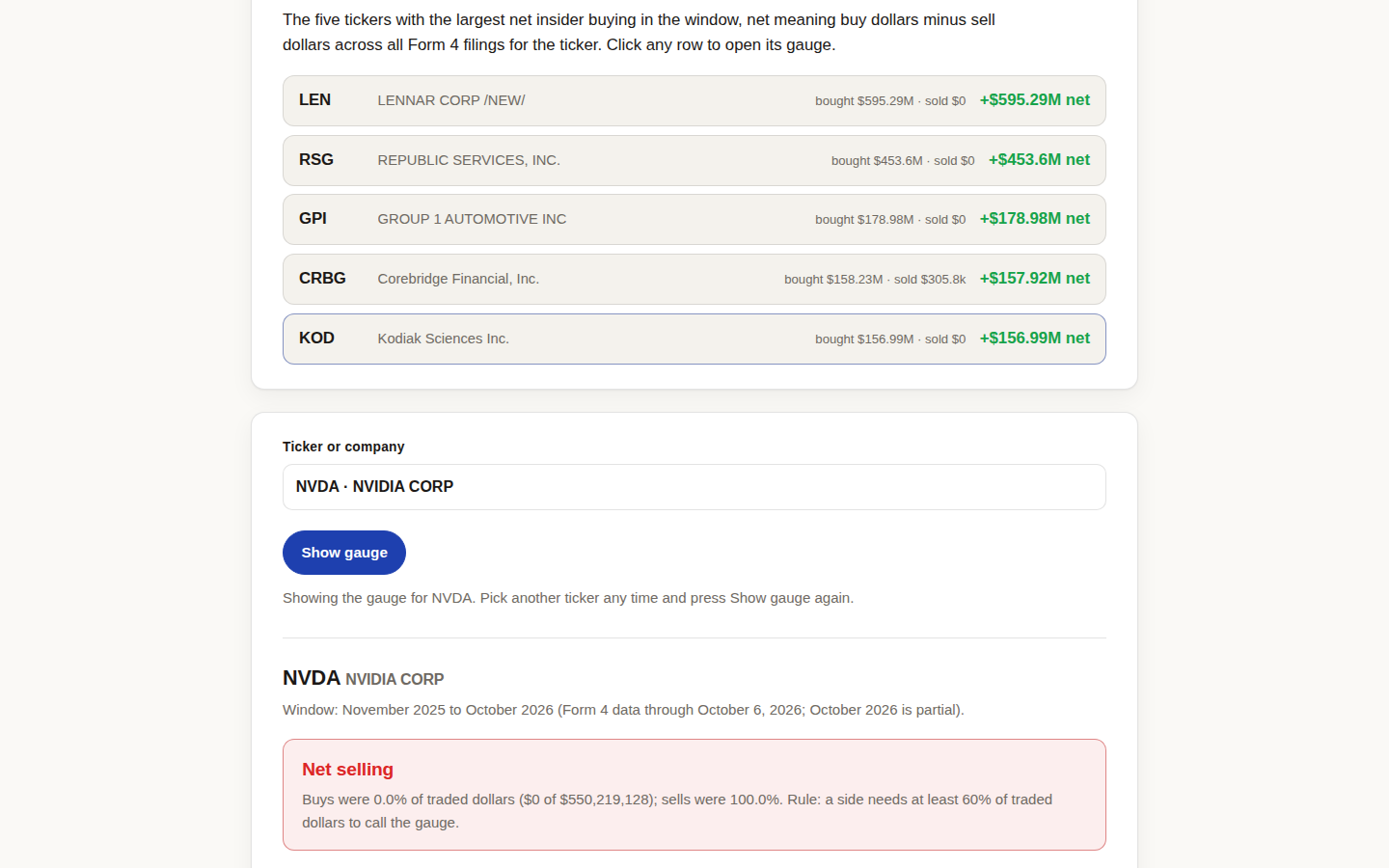
NVDA is the standing warning. The gauge reads net selling on $550.2M, which sounds alarming until the transactions table shows the sells are one director, Mark A. Stevens, across September 2026. Our piece on cluster buys makes the same point in reverse: breadth beats size. Check the unique insiders count before you react to any verdict.
4. Planned sales are not panic
A large slice of executive selling runs on 10b5-1 plans set months in advance. The gauge cannot see the plan, only the trade, which is why we keep the 10b5-1 explainer next to it. A steady monthly drip of same-size sells is usually a plan. A sudden cluster of discretionary sells, from several officers at once, is the pattern worth a second look.
5. The biggest buying board is a research list, not a buy list
The gauge opens with the five tickers with the largest net insider buying in the window: LEN at +$595.29M net, then RSG, GPI, CRBG and KOD. Treat it as a reading list. Open each gauge, look at who bought and when, then do the normal work on the business itself. If dividends are the goal instead, the Dividend Income Builder at DividendDB starts from the income side.
6. Cross-check the verdict against the portfolio
One gauge is a data point. Run the same check across everything you own and the outliers stand out: the one holding where insiders only sell, the one where they quietly buy. The Global Portfolio Builder at WorldMarketStats is where that wider view starts. Then run your own list: open the Insider Sentiment Gauge.